

Not sure which Ecuador tour to choose? Click to see a complete listing and comparison of all our Ecuador trips.
This tour visits the marvelous dry deciduous and humid evergreen forests that comprise a large yet endangered area of southwestern Ecuador. This region contributes a number of unique species to the country's great avian diversity, as it is the northern extension of the Tumbesian endemic center, a critical area for many bird species that can only be found here and in adjacent northwestern Peru. The habitats we will be birding range from high misty Andean forested ridges and dry desert-like intermontane valleys to humid, west-slope foothills and the deciduous Bombax forests and semi-deserts of the central Pacific coast. Several Ecuadorian endemics, including the El Oro Parakeet and the Jocotoco Antpitta, occur along our route, and we will prioritize finding these specialties.
Our tour is designed to maximize our chances for southwestern specialties that complement the avifauna seen on our Jewels of Ecuador tour and minimize overlap. We begin in Guayaquil, bird south of the city, and then do a large loop to the south and east, birding the Buenaventura Reserve near Pinas (three nights, Umbrellabird Lodge), the foundation's lodge at Jorupe Reserve near Macara (four nights, Urraca Lodge), and the Tapichalaca Reserve (three nights, Casa Simpson Lodge), home of the Jocotoco Antpitta. We conclude our trip with lunch at Tapichalaca before catching an evening flight to Quito in order to connect with our international flights home the following day.
As Frank Chapman realized as early as the 1920s, southwestern Ecuador is one of the most complex regions in South America with regard to its biogeography and its avifauna; it is a showcase of diversity and endemism. The dry forests of the southwest (Tumbesian Center of Endemism) support a very high proportion of unique forms (more than forty taxa) and comprise one of the most threatened habitats in South America. We will be in the range of almost half of Ecuador's forty Threatened Birds (Birdlife International/ICBP classification). Our birding will take us to wonderfully biodiverse areas critically in need of protection, as well as to such established preserves as the Jocotoco Foundation reserves at Buenaventura, Jorupe, Utuana, and Tapichalaca. In addition to the numerous species typical of each of the habitats on our route, with the help of some keen, sharp-eyed participants, we can hope to see half to two-thirds of these rarities.
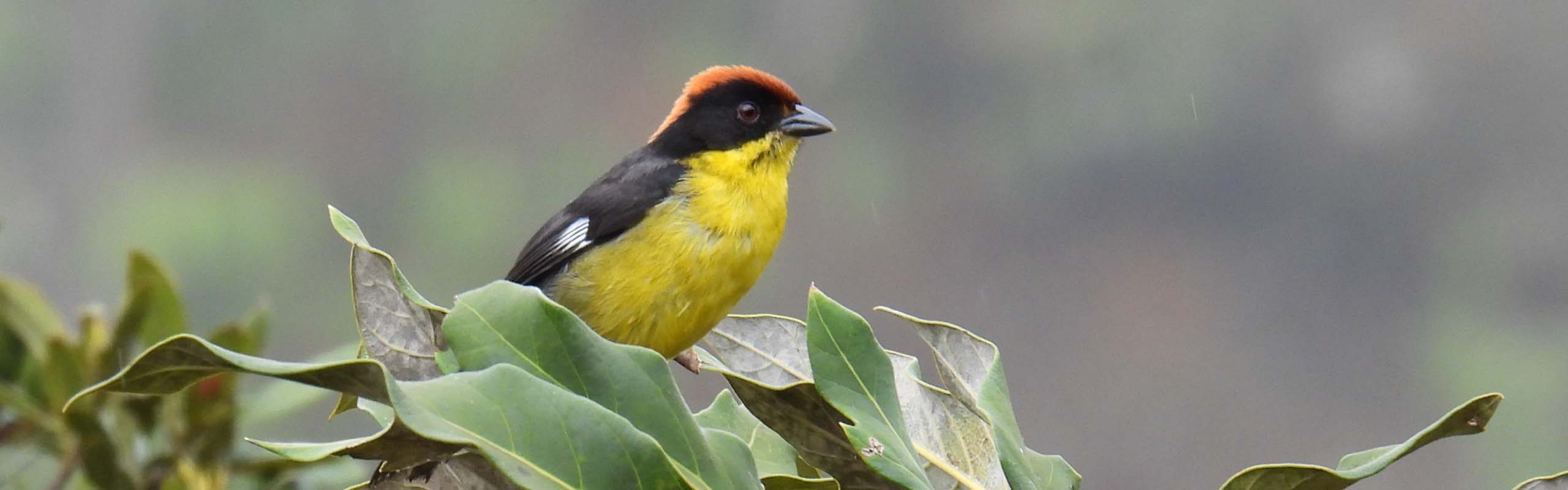
The highlights of this birding fortnight are the birds themselves, a remarkable grouping of beautiful, behaviorally fascinating, endangered, and little-known species. They range from a distinctive Ecuadorian endemic parakeet of the genus Pyrrhura, the El Oro Parakeet (described in 1986 from the province for which it was named, and still known only from El Oro and adjacent Canar) to more than thirty species of hummingbirds, including such fantastic species as White-tipped Sicklebill, Rainbow Starfrontlet, Buff-winged Starfrontlet, Collared Inca, Violet-tailed and Long-tailed sylphs, Little (Flame-throated) and Purple-throated sunangels, Glowing Puffleg, Crowned Woodnymph, Green Thorntail, and Rufous-capped Thornbill. Expect good looks at most of the long list of Tumbesian specialties (including the secretive Watkins's Antpitta and Henna-hooded Foliage-gleaner) and to witness at close range such knock-outs as displaying Club-winged Manakins and singing Red-hooded Tanagers. Past tour groups have had good looks at such wonderful species as Pale-browed Tinamou, Horned Screamer, Gray-backed Hawk, Golden-plumed, White-necked, Red-masked, and Gray-cheeked parakeets, Pacific Parrotlet, Gray-capped Cuckoo, Peruvian Screech-Owl, Andean Pygmy-Owl, Peruvian Pygmy-Owl (often voted most valuable bird for its assistance in attracting many others), Ecuadorian Trogon, Crimson-rumped Toucanet, Choco and Yellow-throated (Chestnut-mandibled) toucans, Gray-breasted Mountain-Toucan, Ecuadorian Piculet, Scarlet-backed, Crimson-mantled, Powerful, and Guayaquil woodpeckers, Pacific Tuftedcheek, Collared and Chapman's antshrikes, Gray-headed Antbird; Chestnut-naped, Equatorial, Plain-backed, and Ochre-breasted antpittas, Elegant Crescentchest, Ecuadorian, Chusquea, and Ocellated tapaculos, displaying Pacific Elaenias, Black-crested Tit-Tyrant (a favorite of many participants), Agile Tit-Tyrant, Rufous-crowned Tody-Flycatcher, Orange-banded and Gray-breasted flycatchers, Jelski's Chat-Tyrant, Ochraceous Attila, Snowy-throated Kingbird, One-colored and Slaty becards, Long-wattled Umbrellabirds, Chestnut-collared Swallow, Speckle-breasted and Superciliated wrens, Maranon, Ecuadorian, and Plumbeous-backed thrushes, the spectacular JayJay, Gray-and-gold Warbler, Crimson-breasted Finch, Black-capped Sparrow, Black-cowled Saltator, White-edged Oriole, Bay-crowned, White-winged, White-headed, and Pale-naped brush-finches; and around thirty species of tanagers and their relatives including Black-eared Hemispingus (of the race piurae), as well as Red-hooded and Golden-crowned tanagers.
The Jocotoco Foundation has comfortable lodges right on their reserves, and as noted above we plan to stay at three of them. One of the highlights of the tour will be staying in their lovely lodge right at the reserve for the Jocotoco Antpitta, and with luck we should see at least one of the group of Jocotoco Antpittas that have been "trained" to come to the trail for earthworms! This magnificent large antpitta, which occurs only in a limited range in southernmost Ecuador and adjacent Peru, was described new to science in 1999. (But remember that antpittas have a mind of their own, and if the ground has been wet—and hence good for earthworms to be active—they may have less incentive to come "on call." But they have been quite reliable in recent years, and we have allowed enough time at Tapichalaca for two tries if need be.) We will also stay at two other Jocotoco Foundation lodges: first at the Buenaventura Reserve's Umbrellabird Lodge in the lush foothills of the west where we will be very near prime habitat for the El Oro Parakeet and the Long-wattled Umbrellabird; and then at the beautifully designed Jorupe Reserve’s Urraca Lodge, where we will bird right in the heart of some of the most well preserved Bombax-dominated, deciduous forest accessible in Ecuador! The Southwest has much to offer!
Select the KEY INFO tab or click here for our itinerary plus space requests, status, fees, limits, and guides for any departure.
Client comment
"I've traveled with Field Guides on birding tours twice before, and I check your website frequently. My overall experience was excellent. I particularly liked the three Jocotoco Foundation lodges and the reserves surrounding them. We didn't move much, stayed several nights at each lodge, which was nice. Meeting, birding with and traveling with guide Willy Perez was the highlight of the trip. Of course, his birding skills are exceptional, but his upbeat, unassuming personality is of special note. Willy has a welcoming and friendly nature...he is funny, kind, and was very aware of the needs of each person in the group." J.T., SOUTHWESTERN ECUADOR SPECIALTIES tour participant
Combo Tours
If you would like a longer birding holiday, some departures of this tour may be combined with:
SOUTHEAST ECUADOR: Orange-throated Tanager & Foothill Specialties
Other Tours in ECUADOR
AMAZONIAN ECUADOR: SACHA LODGECLOUDFORESTS OF ECUADOR: All the Best of the Wild Northwest
ECUADOR'S WILDSUMACO LODGE
GALAPAGOS: An Intimate Look at Darwin's Islands
HOLIDAY AT SAN ISIDRO, ECUADOR
JEWELS OF ECUADOR: HUMMERS, TANAGERS & ANTPITTAS
SOUTHEAST ECUADOR: Orange-throated Tanager & Foothill Specialties