

Costa Rica is in many ways Central America's most attractive country. With its friendly people, democratic government, and striking scenery of volcanic cordilleras and lush tropical forest, it attracts visitors and settlers from all parts of the world. Costa Rica also holds a strong attraction for naturalists and students of tropical biology, who have come in large numbers to this tremendously rich area. Though the country is smaller than the state of West Virginia, there are more than 850 species of birds, a reflection of two important features: Costa Rica's great variety of habitats and its location between tropical South America and temperate North America.
The geological history of Costa Rica has had an enriching effect on the country's natural history. As part of the land bridge that connected North and South America some five million years ago, Costa Rica was a mixing ground for birds from the north and south, a fact well reflected in the country's avifauna today. Here we find a strong representation of Neotropical families such as hummingbirds, motmots, potoos, jacamars, puffbirds, and toucans. In proportion to its size, Costa Rica's diversity parallels that of the Andean countries of South America. Many of the habitats are similar: lowland rainforest at La Selva in the Rio Sarapiqui region, misty cloudforest at Monteverde, cool temperate forest on the slopes of volcanoes, and even paramo atop Cerro de la Muerte. On the Pacific slope, the transition from humid forest to drier habitats more typical of northern Middle America adds yet a different dimension. Although the diversity here is great, preparation for a visit to Costa Rica is no longer the daunting task it once was. The classic field guide by Stiles and Skutch and a newer guide by Garrigues and Dean make studying for a trip here a real pleasure!
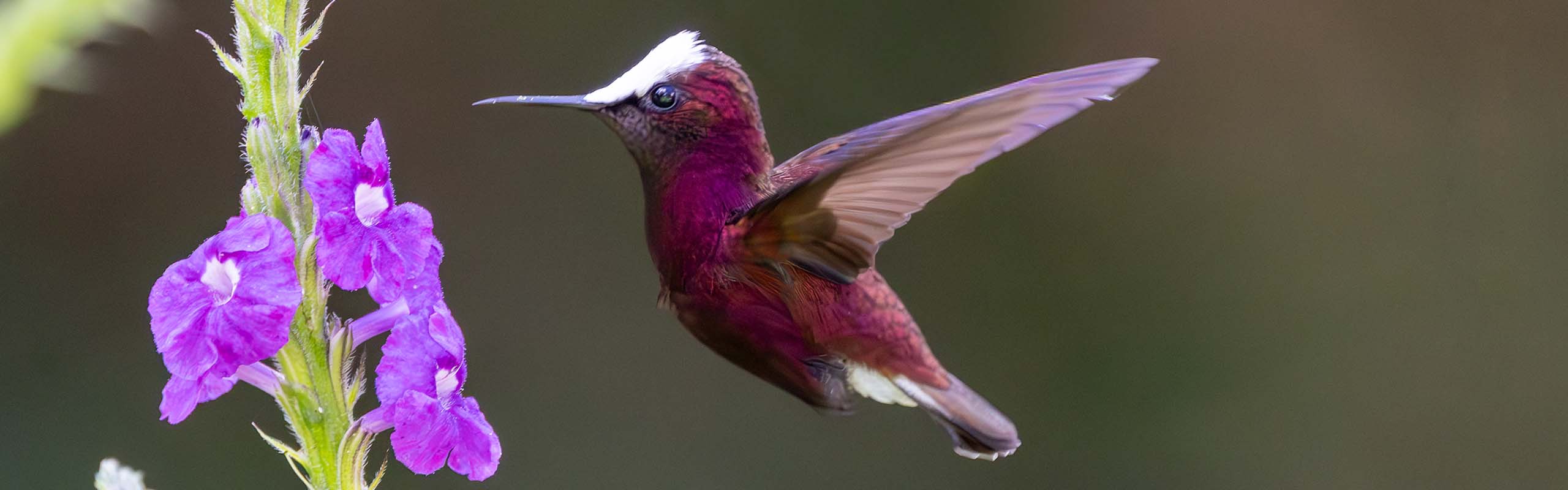
This birding tour will sample nearly all of Costa Rica's major habitats and seek out many of the endemics and specialties of the area. We'll spend some time at two different sites in the lush forests of the Caribbean foothills--Braulio-Carrillo National Park and Rancho Naturalista--where possibilities include Black-crested Coquette, Green Thorntail, the local Snowcap, Lattice-tailed Trogon, Dull-mantled Antbird, Sharpbill, White-throated Shrike-Tanager, Blue-and-gold and Emerald tanagers, and even Lanceolated Monklet. Farther down the Caribbean slope, we'll visit the Rio Sarapiqui region and La Selva Biological Station. A focus for many of the tropical studies in the country today, the preserve and surrounding area at La Selva are home to an impressive array of specialties, from the beautiful Great Green Macaw and Snowy Cotinga to Black-capped Pygmy-Tyrant and Black-throated and Canebrake wrens.
We'll also travel to three very different areas in the mountainous backbone of the country, each at a different elevation and home to a slightly different cross section of birds. At Monteverde, we'll seek (among many other species) Black-breasted Wood-Quail, the scarce Bare-shanked Screech-Owl, Coppery-headed Emerald (a Costa Rican endemic), Prong-billed Barbet, and Three-wattled Bellbird; at Tapanti National Park, targets include Black-bellied Hummingbird, White-bellied Mountain-gem, Barred Becard, Golden-browed Chlorophonia, and Sooty-faced Finch; and at Cerro de la Muerte, in addition to the spectacular Resplendent Quetzal, which can be quite common here, we'll search for the feisty Fiery-throated Hummingbird, Timberline Wren, Wrenthrush, Yellow-thighed Brushfinch, and Volcano Junco.
In the Pacific lowlands, we'll spend several days in and around Carara National Park, situated in the transition zone between the dry northwestern lowlands and the more humid southern Pacific slope. Birds such as Baird's Trogon, Fiery-billed Aracari, Orange-collared Manakin, and Black-hooded Antshrike reach the northern limits of their range here, while species more typical of northern Central America that can also be found here include Turquoise-browed Motmot, Lesser Ground-Cuckoo, and White-throated Magpie-Jay. Mangroves and coastal mudflats add another dimension to the birding here and serve to make this region one of the most diverse in the country. Join us this summer and discover for yourself why Costa Rica continues to be one of the most popular birding destinations in the Americas!
Select the KEY INFO tab or click here for our itinerary plus space requests, status, fees, limits, and guides for any departure.
Other Tours in COSTA RICA
CLASSIC COSTA RICACOSTA RICA: BIRDING THE EDGES
HOLIDAY COSTA RICA: Rancho Naturalista