

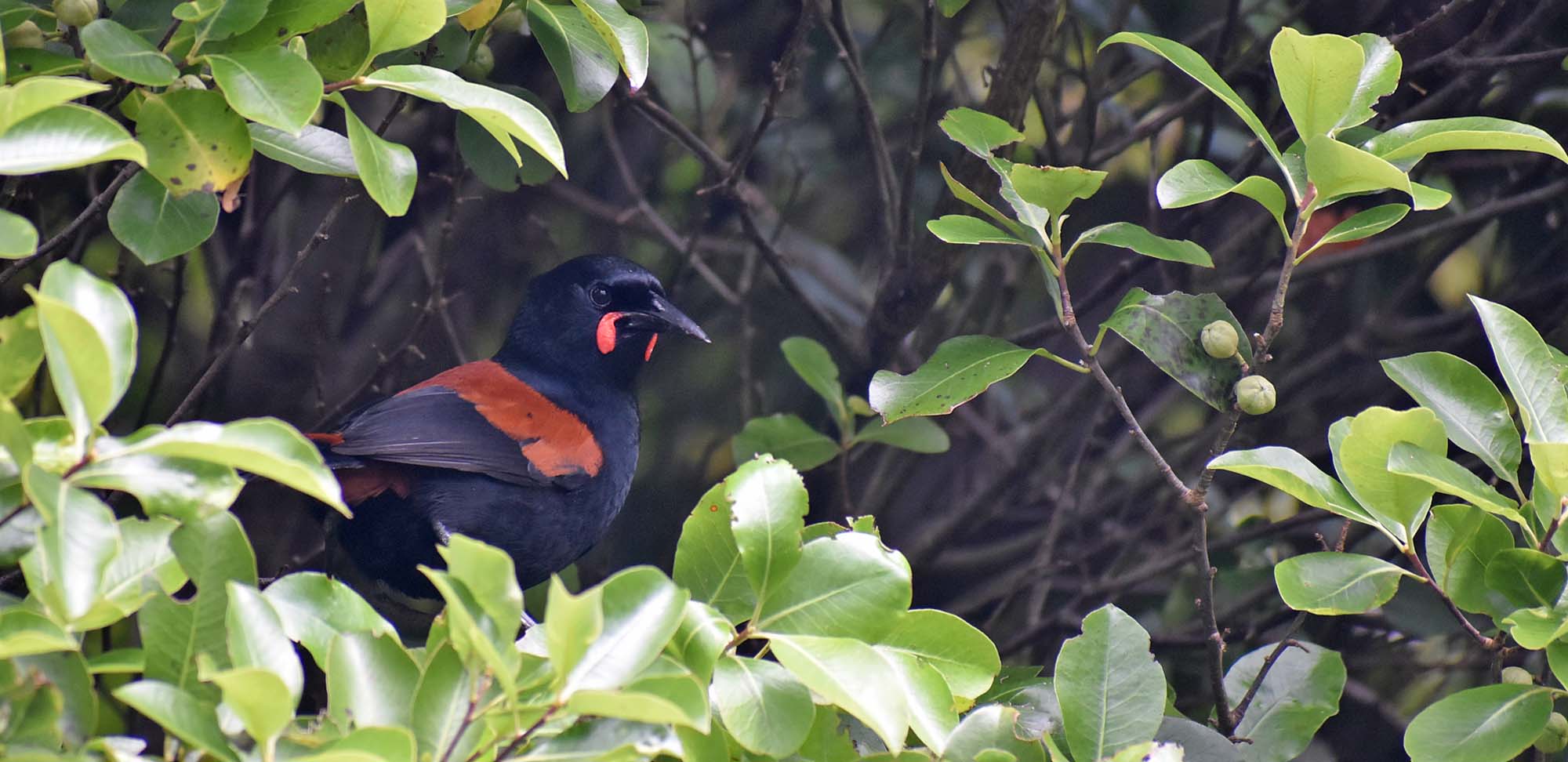
With its picturesque landscape of mountains, meadows, and fjords, New Zealand, or Aotearoa--"he land of the long white cloud" in Maori--is an enchanting land. Like its nearest neighbor, Australia, New Zealand has remained isolated for millions of years since the split of the continental plates, a fact reflected in the lack of land mammals (there are no native land mammals except a couple of endangered bats) and in the ancient derivation of its avifauna. This is the home of such primitive families of birds as the amazing kiwis, New Zealand wattlebirds like the Kokako, Saddleback, the extinct Huia, and the New Zealand wrens.
Although New Zealand supports relatively few species of land birds, it boasts six endemic families (kiwis, New Zealand parrots, New Zealand wrens, wattled crows, mohouas, and stitchbird) and some 45 endemic species on the main islands. Some of these, such as the Saddleback, the Kokako, and the Stitchbird, are among the most endangered birds on Earth. There have been massive habitat changes since Maori settlement began a thousand years ago, followed by the huge impact of European settlement in the nineteenth century. The menace of introduced mammals like cats, stoats, rats, and possums means that many of the New Zealand birds are now to be found only in island sanctuaries or in remnant native forests. The New Zealand Department of Conservation has done an outstanding job of conserving these precious fragments, with very successful reintroduction programs for some of the rarest species. We shall visit many of the prime sites to get an idea of what the place was like in the not-so-distant past.
New Zealand is situated in a temperate/subtropical ocean convergence zone, and as such is richly endowed with seabirds; indeed, it is one of the cradles of seabird evolution. Boat trips off North, South, and Stewart islands and visits to several coastal sites will allow us to experience close at hand the tremendous variety of marine birds and mammals of this region. Our travels will take us to many places of great scenic beauty on North and South islands, from the snow-bound Mount Cook massif to the deep-water upwellings off the seaward Kaikouras, incredible glacier-ringed Milford Sound in Fiordland National Park, and the wild and remote Stewart Island, where the rare Yellow-eyed Penguin nests. Join us this year for a most pleasurable springtime birding tour of New Zealand!
Hauraki Gulf Pelagic Extension
The short optional extension after the main tour includes an all-day pelagic on the Hauraki Gulf off the northeast coast of the North Island, with New Zealand Storm-Petrel, rediscovered in 2003 after it was believed extinct for 50 years, as the main target!
Select the KEY INFO tab or click here for our itinerary plus space requests, status, fees, limits, and guides for any departure.