

Not sure which Ecuador tour to choose? Click to see a complete listing and comparison of all our Ecuador trips.
One of the most common comments we hear from birders after a three or four-day birding stay in Ecuador's eastern Andes is, "You know, I sure would have loved a few more days here--there's so much to see and explore!" IIf you'd love to have that extra time, this is your opportunity. We'll be based primarily at a quiet, very comfortable family-run cloudforest lodge famous for its delicious home-cooked meals; it also just happens to feature a birdlist riddled with such glamorous species as Black-billed Mountain-Toucan, Andean Cock-of-the-rock, and White-capped Tanager and has become one of the most popular birding destinations in Ecuador.
San Isidro Lodge (a.k.a. Cabañas San Isidro) is an old Ecuadorian hacienda situated at about 6800 feet on the eastern slope of the Andes. Its natural environment has been carefully maintained by the Bustamante family for more than fifty years, and upon arrival, one is immediately struck by the forested views on all sides. San Isidro's private reserve is sandwiched between critical and pristine national park lands that make it all the more rich and beautiful: to the west, temperate forest leads undisturbed right up to distant jagged paramo cliffs (too far to walk to, of course!), while viewing east and south, one can see the forest-cloaked, knife-edge ridges of the Cordillera de Guacamayos. It will be hard to ignore the strange whistles of the loud and gregarious Subtropical Cacique and the chipper song of the Black-billed Peppershrike as they call to us during our first look around. Time to get birding!
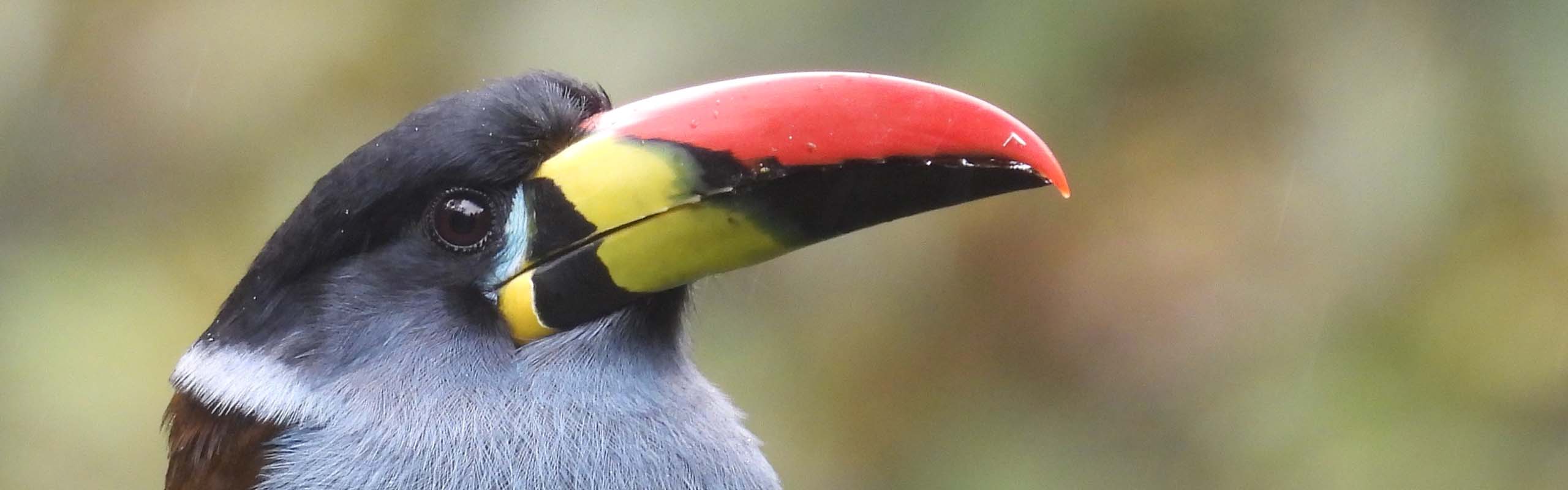
Our itinerary begins with an overnight in Quito, after which a cloudless blue morning may allow for a clear view of the "Avenue of the Volcanoes." Snow-capped peaks, including Cotopaxi, Antisana, and Cayambe, line the crest of Ecuador's northern Andes. On our first day, we will spend most of the time birding the extensive paramos of Antisana Reserve. We will probably want to kick off our birding, though, right around the Hotel San Jose de Puembo, where the gardens attract a nice selection of the inter-Andean species that we always look for in the drier habitats on our way up to the higher areas, Western Emerald, Scrub and Blue-and-yellow Tanagers, Rusty Flowerpiercer, Golden Grosbeak, and Golden-rumped Euphonia among them. After a short bout here, we will set our sights on the extensive highland paramos that blanket the slopes around Volcan Antisana. On a good morning, we have excellent chances of finding many of the special species typical of higher elevations, as well as some rarer (more restricted) species, like Andean Condor, Andean Lapwing, Black-faced Ibis, Carunculated Caracara, Ecuadorian Hillstar, Black-winged Ground-Dove, Andean Tit-Spinetail, Many-striped Canastero, and Tawny Antpitta. A short walk to Mica Lake will certainly yield Silvery Grebe, Andean (Ruddy) Duck, Andean Teal, Yellow-billed Pintail, and Slate-colored Coot. A stop at some productive hummingbird feeders en route could very well turn up Giant Hummingbird and Shining Sunbeam. It's all good! The scenery is nothing less than spectacular, and if we have a clear day, Antisana's snow-covered peaks--seemingly within reach--will be seen towering above us to the north. Wrapping up our birding here (early/mid-afternoon), we will back-track to the main highway that leads over the Papallacta Pass, our gateway to the east! Time permitting, we will hope to search out a few more paramo species more typical of this area, including Rufous-bellied Seedsnipe, Red-rumped Bush-Tyrant, Giant Conebill, or a flock of Black-backed Bush-Tanagers. Then we'll wind down a breathtaking valley, through a variety of montane forest habitats with some of the most dramatic avian treasures of the Andes, from the long-billed Sword-billed Hummingbird to the tiny-billed Mountain Avocetbill, and from the subtly beautiful Gray-breasted Mountain-Toucan to the brilliant Turquoise Jay. To make our survey of the eastern slope's riches complete, we'll first spend one night en route to San Isidro at Guango Lodge, with some of the finest hummingbird syrup anywhere!
At San Isidro, we'll have ample time to explore the numerous forest trails and wooded roadsides near the lodge. Just a few possibilities include White-rumped Hawk, Sickle-winged Guan, White-capped Parrot, Golden-headed and Crested quetzals, Crimson-mantled Woodpecker, Tyrannine Woodcreeper, and Saffron-crowned, Flame-faced, Golden-naped, Beryl-spangled, and Black-capped tanagers. But this is just the beginning! Within short walking distance of the lodge a Barred Antthrush awaits us somewhere in the understory of dense, mossy bamboo forest, while along the first stretches of a log trail not far away, a Crested Quetzal vies for our attention as it whistles its two-noted song from a high, hidden perch. More than once while enjoying lunch out on the porch, we have lucked into an exquisite group of White-capped Tanagers that travel about in noisy nomadic bands, or a magnificent Black-and-chestnut Eagle taking advantage of the heat waves of a sunny afternoon to soar. A late-afternoon hike down one of the trails below the cabins leads to a small Andean Cock-of-the-rock lek, and we have a good chance of seeing a few of these glorious creatures. And as the sun begins its descent behind the mountains, the Wattled Guans ascend to their favorite singing perches atop tall trees and belt out their strange, far-carrying growls.
During our stay at San Isidro, we are bound to run into a rainy morning or afternoon, but not to worry. The hummingbird feeders at the dining room attract a menagerie colorful enough to dazzle anyone: Chestnut-breasted Coronet, Bronzy and Collared incas, Long-tailed Sylph, Sparkling Violetear, Speckled Hummingbird, and Fawn-breasted Brilliant are all regulars. We could even luck into a male Gorgeted Woodstar, a tiny hummer known to hit the feeders from time to time. The forests right next to this very same gazebo often produce Yellow-vented Woodpecker, Chestnut-breasted Chlorophonia, Streak-headed Antbird (split from Long-tailed), Rufous-crowned Tody-Flycatcher, and Handsome Flycatcher in a single rainy morning--an impressive collection of attractive birds.
One of the latest attractions--as seems to be the trend now in Ecuadorian birding--is the taming of a pair of White-bellied Antpittas; the birds emerge from their dark environs to feed on worms laid out for them on the trail. This species can be exceptionally tricky to see under normal birding circumstances, but here, within shouting distance of the dining room, they have learned that enduring a group of eager birders is well worth it. Sometimes it takes more than one try, but we have had mostly excellent luck. Depending on our luck, we may even see a Chestnut-crowned Antpitta coming into gobble down worms at Guango, where a pair has recently been habituated, but this species seems to be more temperamental. We will certainly give it a try!
To complete our sampling of the eastern slope's riches, we’ll also spend one or two full days of birding in the foothills of the area. How can you top flocks with birds like Scarlet-breasted Fruiteater, Deep-blue Flowerpiercer, Bronze-green Euphonia, and Orange-eared, Golden, Paradise, and Golden-eared tanagers? Here we've had fantastic studies of both Blue-browed and Vermilion Tanagers. Or how about a Solitary Eagle or Black Hawk-Eagle flying by, or a Coppery-chested Jacamar sitting about? We will also make a stop at a hummingbird feeder station, which is usually very active this time of the year with the likes of White-tailed Hillstar, Golden-tailed Sapphire, Many-spotted Hummingbird, Fork-tailed Woodnymph, Violet-headed Hummingbird, Black-throated Brilliant, and even sometimes Wire-crested Thorntail. There is much to see and do, and our San Isidro itinerary promises a delightfully exciting and distracting holiday break in a beautiful, peaceful setting.
Select the KEY INFO tab or click here for our itinerary plus space requests, status, fees, limits, and guides for any departure.
Other Tours in ECUADOR
AMAZONIAN ECUADOR: SACHA LODGECLOUDFORESTS OF ECUADOR: All the Best of the Wild Northwest
ECUADOR'S WILDSUMACO LODGE
GALAPAGOS: An Intimate Look at Darwin's Islands
JEWELS OF ECUADOR: HUMMERS, TANAGERS & ANTPITTAS
SOUTHEAST ECUADOR: Orange-throated Tanager & Foothill Specialties
SOUTHWESTERN ECUADOR SPECIALTIES: Jocotoco Foundation Reserves