

Not sure which US tour to choose? Click to see a complete listing and comparison of all our US trips.
Hawaii stands alone among the states. First, it's a Pacific Island, with the warm weather, gorgeous beaches, coconut palms, tropical fish, and cooling ocean breezes that the name implies. Second, it boasts more than two dozen endemic species, some of which have become staggeringly rare. It is also a beautiful and diverse state, with each island having its own unique character created by differing weather, geology, and birdlife. The archipelago of Hawaii was formed as the tectonic plate on which it lies moved over a "hot spot" in Earth's crust. The plate moves northwestward, so the oldest main island is Kauai in the northwest part of the chain, and the newest is Hawaii (the Big Island) in the southeast. The Big Island is not only new, but it's growing daily. As each island has risen out of the sea, new land has become available for plants and birds to colonize, and each island has several endemic bird species. Finally, the fact that it is a series of islands makes Hawaii great for sea-birding, as well as enjoying the marine mammals, tropical reefs, and fish found beneath the water's surface.
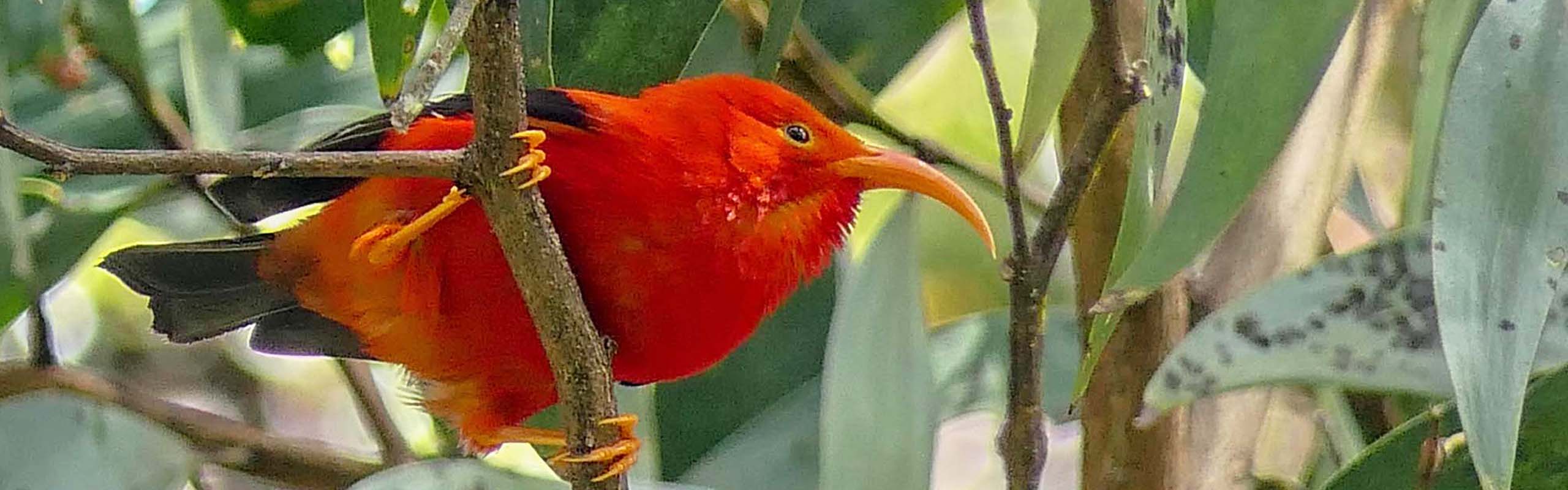
Concentrating on the birds, Hawaii is a prime spot to think about the concept of adaptive radiation. New colonists to an area with many open niches may evolve into many different varieties--eventually different species--that exploit these available niches. This is what Charles Darwin saw with the "finches" on the Galapagos Islands, and exactly what you see with the endemic birds of Hawaii. There is the Palila, a finch-like species with a thick bill specially adapted to crack the seeds from its dry Mamane forest habitat. The gorgeous red I'iwi and 'Apapane are specially adapted to forage for nectar and even resemble the color of the native Ohi'a Lehua blossoms. The Hawaii Amakihi has a narrow, curved bill that is well adapted for nectaring from native flowers, but it can also forage on smaller seeds and insects. The more thickset bill of the Kauai Amakihi allows it to take a bit more seed in its diet. The creepers, such as the Hawaii Creeper of the Big Island and the critically endangered Akikiki of Kauai, inch along tree trunks and branches, probing for insects in bark crevices with their pointed, dexterous bills. The 'Akepa of the Big Island and the critically endangered Akeke'e of Kauai have short, pointed bills with slightly crossed tips; in the manner of the mainland's crossbills, these birds use their specialized beaks to pry open tree buds (rather than pine cones, as the crossbills do) and find insects hidden there. Perhaps the most specialized adaptation is the bill of the Akiapola'su; it has a long, curved upper mandible and a shorter, more peg-like lower mandible. With the lower mandible, it pries off bark flakes as a woodpecker does, and with the upper mandible, it spears grubs to pull them from crevices in the bark. It's an incredible way to see Darwin's theory in action, in an even more striking manner than is seen on the Galapagos Islands. Hawaii truly is a paradise for the birder and naturalist.
The native birds of Hawaii also include the Hawaiian thrushes, which are really members of the solitaire genus Myadestes. These thrushes are found up in the trees, but often nest in wet, mossy banks. As is typical with the group, their vocalizations are eerie and complex. The Oma'o on the Big Island is uncommon but not too difficult to find, but its counterpart, the Puaiohi on Kauai, is sadly much rarer, and seeing it is beyond the scope of this tour. Finally, a trio of 'elepaios--monarch flycatchers, which cock their tails up like wrens do--are separated out across the main islands. In addition, we'll find a wide assortment of introduced species from all corners of the globe. The way in which some of these foreign species have adapted to the habitats in Hawaii is interesting. Not all have become common and widespread; some are rather local and difficult to see. Given that in the lowlands native birds are not usually present, these exotics will keep the focus wheels of our binoculars working as we enjoy their beautiful colors and songs. And now, most of these birds will count towards your ABA list!
Towering mountains, active volcanoes, black sand beaches, highland forests, dry forests, semi-desert coastlines--you name it, it's found in this gorgeous and birdy state!
Select the KEY INFO tab or click here for our itinerary plus space requests, status, fees, limits, and guides for any departure.
Client comment
"This was a wonderful birding tour experience; I keep thinking back to the trip and various highlights; so many good memories of the location, the group, the guides, and the wonderful birds. It's not possible to see hundreds of species in a remote archipelago like Hawaii, but about two-thirds of the birds that we did see were new to me. Our guides, Cory Gregory and Mandy Talpas, were both experts at bird ID, very personable and professional, well organized, and fun!! I am so, so glad I made this trip." --T.M., HAWAII tour participant
"An excellent experience. Great birds and guides. Lodging and food were fine too. We have been very happy with all of our Field Guides tours. We have done a few with other companies but keep coming back. We know that we will have a good and safe trip." R.S., HAWAII tour participant
Other Tours in USA
ALASKA FALL GOLDMINE: Rarities on the Pribilofs & Ross's Gulls in BarrowALASKA: NO PLACE LIKE NOME
ALASKA: THE GREAT LAND
ARIZONA MINDFUL BIRDING RETREAT: SEDONA
ARIZONA NIGHTBIRDS & MORE
ARIZONA WINTER SPECIALTIES
ARIZONA'S SECOND SPRING
ARIZONA: BIRDING THE BORDER
BIRDING THE DAKOTAS: Prairies, Black Hills & Badlands
COLORADO GROUSE
FALL FOR CAPE MAY
FLORIDA: Mangroves & Migrants
LOUISIANA: YELLOW RAILS & CRAWFISH TAILS
MAINE IN FALL: Seabirds & Coastal Migrants
MICHIGAN: GREAT LAKES GRANDEUR
NEBRASKA: CRANES WITH CORY
NEW MEXICO: Birding the Land of Enchantment
NORTHERN ARIZONA'S CANYONS & CONDOR
OREGON: From the Coast to the Cascades
SLICE OF CALIFORNIA: Seabirds to Sierra
SOUTH TEXAS RARITIES
SPRING IN CAPE MAY
TEXAS COAST MIGRATION SPECTACLE